
Outside Counsel Guidelines: Keeping Them Current and Enforced
Written By: Quality Control Department
KEY TAKEAWAYS
Outside counsel guidelines are the billing and engagement standards a corporate legal department sets for its law firms, and they set the rules of engagement.
Guidelines lose their efficacy as billing practices change, and need regular review to stay aligned with how law firms bill now.
Guidelines help control outside counsel spend only when a violation becomes a realized adjustment that the law firm accepts.
Outside counsel guidelines set the rules of engagement before the first invoice arrives. They tell every law firm what a corporate legal department will and will not pay for, and they give both sides one standard to work from. For guidelines to help control outside counsel spend, legal departments have to review them regularly and put a process in place to enforce them against incoming invoices.
Like any set of rules, outside counsel guidelines govern as long as they stay current and someone holds law firms accountable to them. Guidelines that have not been recently reviewed or updated stop matching up to how law firms bill today, and a set that no one checks against incoming invoices allows legal spend to leak through. This piece covers what outside counsel guidelines are, why they need regular review, and what it takes to enforce them so legal budgets are protected.
What Are Outside Counsel Guidelines
Outside counsel guidelines (OCGs) are the formal billing and engagement standards a corporate legal department sets for the law firms it hires. Clear OCGs define which activities are billable and which are not, set rate expectations by timekeeper level, establish rules for billing increments and block billing, govern staffing and who may bill on a matter, list reimbursable and non-reimbursable expenses, and specify how invoices must be formatted and submitted. Some now include how technology-assisted work may be billed, as the use of AI becomes more prevalent in legal work.
Without a shared standard, every law firm can bill its own way, producing inconsistent formats, vague narratives, surprise expenses, and time entries that are difficult to understand. With a set of clear guidelines, legal departments and the law firms they work with operate from one objective reference for what acceptable billing looks like.
How specifically the guidelines are written has a direct effect on how enforceable they are. A guideline that states exactly how an issue is handled, for example, a fixed adjustment of 20% for block-billed entries, leaves little room for argument. OCGs that speak in general terms leave more room for interpretation, while precisely written rules apply more consistently across law firms and across invoices.
Why Reviewing and Updating Guidelines Matters
Outside counsel guidelines are not a set-and-forget document because the billing practices they govern constantly change. Guidelines established years ago may include a rate cap that sits below the market today, or fail to account for the mix of more senior attorneys a law firm now staffs for a matter. As new matter types enter the portfolio, outside counsel adopt new staffing models, changing invoice formats and codes, so OCGs need to be updated to match how work is actually billed.
Any changes to guidelines should be documented and sent to each law firm before their engagement begins, so the rules stay transparent. Guidelines that are never revisited enforce yesterday's expectations against today's invoices. Regularly reviewing guidelines works through these questions before a problem surfaces:
When were the guidelines last reviewed against how your law firms bill now?
Do the rate expectations still reflect current market rates for the work and the markets your law firms operate in?
Have new matter types, new law firms, or new billing arrangements appeared since the last revision, and do the guidelines address them?
Are changes communicated to each law firm and acknowledged before they take effect?

Gap Analysis
See how your Outside Counsel Guidelines compare against the provisions our U.S.-based licensed attorneys rely on to identify and defend billing adjustments.
Guidelines Without Enforcement Are Shelfware
Consistently applying established guidelines, invoice after invoice, across every law firm, is where most of the work of effective OCGs lives. Guidelines without enforcement remain just a document that describes the billing a department will accept, while the billing it actually pays goes unchecked.
Enforcing guidelines entails identifying a billing issue, applying contextual judgment, and resolving the adjustment by gaining agreement with the law firm. That work requires a review program carrying a bill through all three stages of bill review.
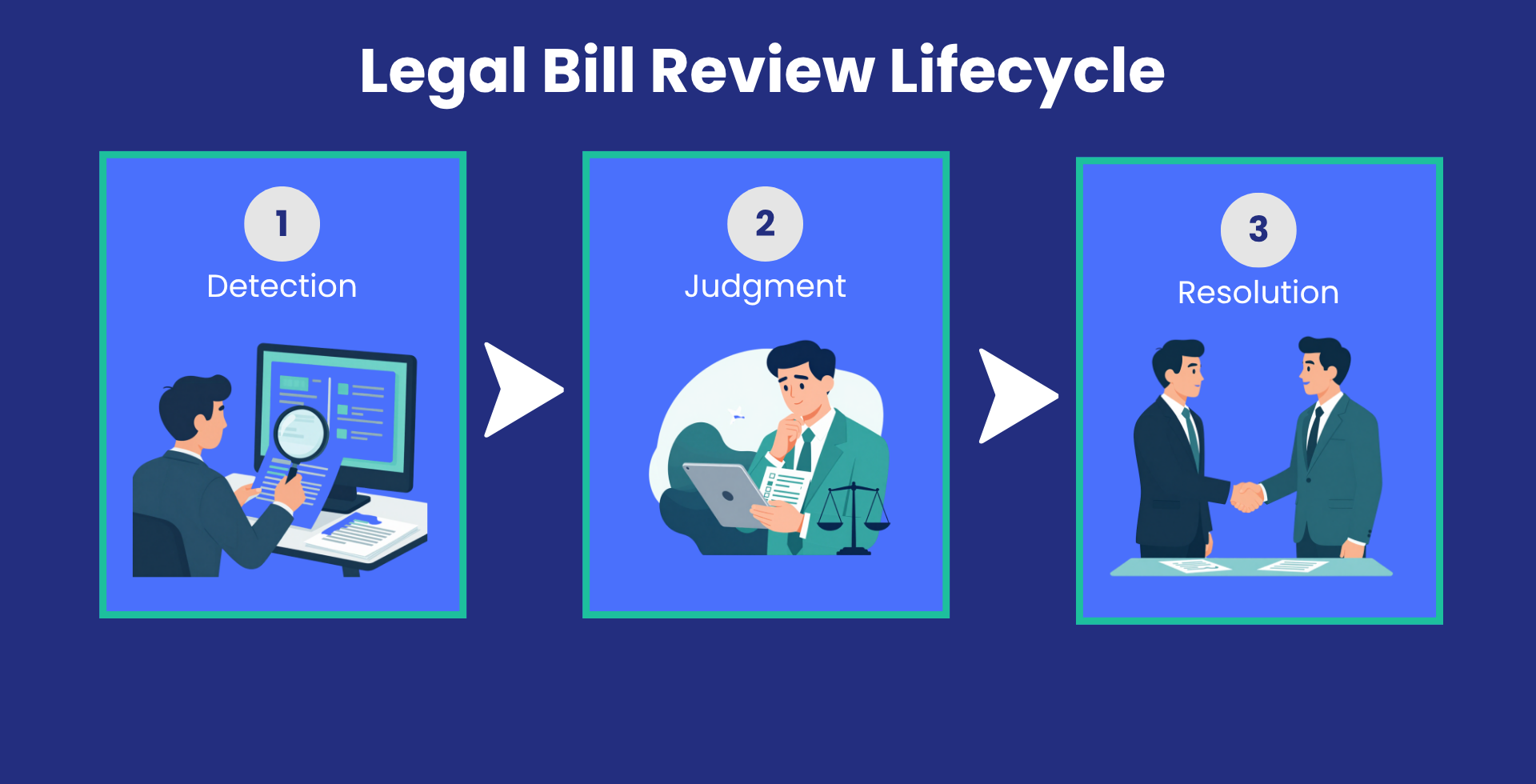
Detection is identifying which entries on an invoice need further evaluation. When detection is run thoroughly, it accounts for what an automated rules-based system surfaces correctly, what it surfaces in error, and what it misses entirely.
Judgment weighs each line item in the context of the work behind it. This determines what genuinely holds up, then frames the reasoning for any adjustment so it stands up to the law firm's review.
Resolution is where an adjustment is settled with the law firm and agreed to. A proposed change holds no value until the law firm agrees to it, which calls for documented reasoning and the credibility to defend each adjustment.
A flag is not an adjustment. A charge that is detected and then never judged or resolved leaves the invoice exactly as it was billed.
INSIGHT: An April 2026 Chicago Tribune investigation examined how the City of Chicago paid outside counsel invoices while running an e-billing system built to flag billing problems. Over the course of a decade, the system flagged roughly 1,500 invoices because a timekeeper was logged at more than 10 hours in a day, but the City reduced payments on just 139 of them. One invoice covering a trial month listed 162 instances of a timekeeper's daily work exceeding 10 hours. The City paid all of them, including nearly $70,000 for time past the 10-hour mark. While the rules existed, the steps that turn a flag into a corrected invoice were not followed.
Sustaining that follow-through across every invoice and every law firm takes capacity and consistency that a lean legal department does not always have to spare. Departments handle this in different ways: reviewing invoices in-house against the guidelines, relying on an e-billing system to surface issues for the internal team to act on and resolve, or engaging a managed bill review service that owns the line-item review and the law-firm-facing resolution. Each fits a different combination of invoice volume, billing complexity, internal capacity, and how much of the work a department wants to own.
INSIGHT: As a managed, attorney-led service, LegalBillReview.com runs the full lifecycle. Every line item on every invoice is analyzed against the client's guidelines, and each discrepancy is documented with the reasoning behind the adjustment. Attorneys reviewing invoices are assigned by subject matter, while a separate Law Firm Relations team, drawn from BigLaw and Fortune 100 backgrounds, resolves adjustments with law firms on a peer-to-peer footing.
Conclusion
A set of outside counsel guidelines is only as useful as the upkeep behind it. Knowing what the guidelines say is the starting point, but the budget is protected by two ongoing habits: reviewing the document so it keeps pace with how law firms actually bill, and enforcing it on every invoice so a violation becomes a realized adjustment rather than a paid charge. A current set of guidelines that no one enforces changes nothing, and enforcing a set that has gone stale only applies rules that no longer fit.
In-house legal teams that know when their guidelines were last updated and how a violation is enforced are better equipped to find where their budget is leaking and strengthen their bill review program.
Contact LegalBillReview.com to see how outside counsel guidelines are drafted, maintained, and enforced on every invoice.