
5 Common Outside Counsel Billing Errors
Written By: Quality Control Department
KEY TAKEAWAYS
Common outside counsel billing errors are block billing, vague time-entry narratives, administrative work billed as legal time, overstaffing, and duplicative work.
In LegalBillReview.com's review of bills from mid-market to Fortune 500 companies, 56% of outside counsel invoices contained some form of errors or non-compliance.
Finding a billing error is not the same as correcting it. A flag only becomes a realized adjustment when an attorney-in-the-loop applies judgment and resolves it with the firm.
More than half of outside counsel invoices contain at least one billing error. In LegalBillReview.com's internal review of bills from mid-market to Fortune 500 companies, 56% had errors or non-compliant charges: block billing, vague entries, clerical work at legal rates, overstaffing, and duplicate work are among the most common.
While many are never caught, even the ones that are still get paid more often than they should, because identifying a billing error and getting the law firm to accept the adjustment are two different things. This piece covers five common errors that show up, and the process that turns a flagged charge into savings the client actually keeps.
The Bill Review Lifecycle
A billing discrepancy is only worth something once it becomes an adjustment that the law firm has accepted. Getting it there requires a bill going through the bill review lifecycle because savings begin to leak when a discrepancy stalls at any of these stages: detection, judgment, and resolution.
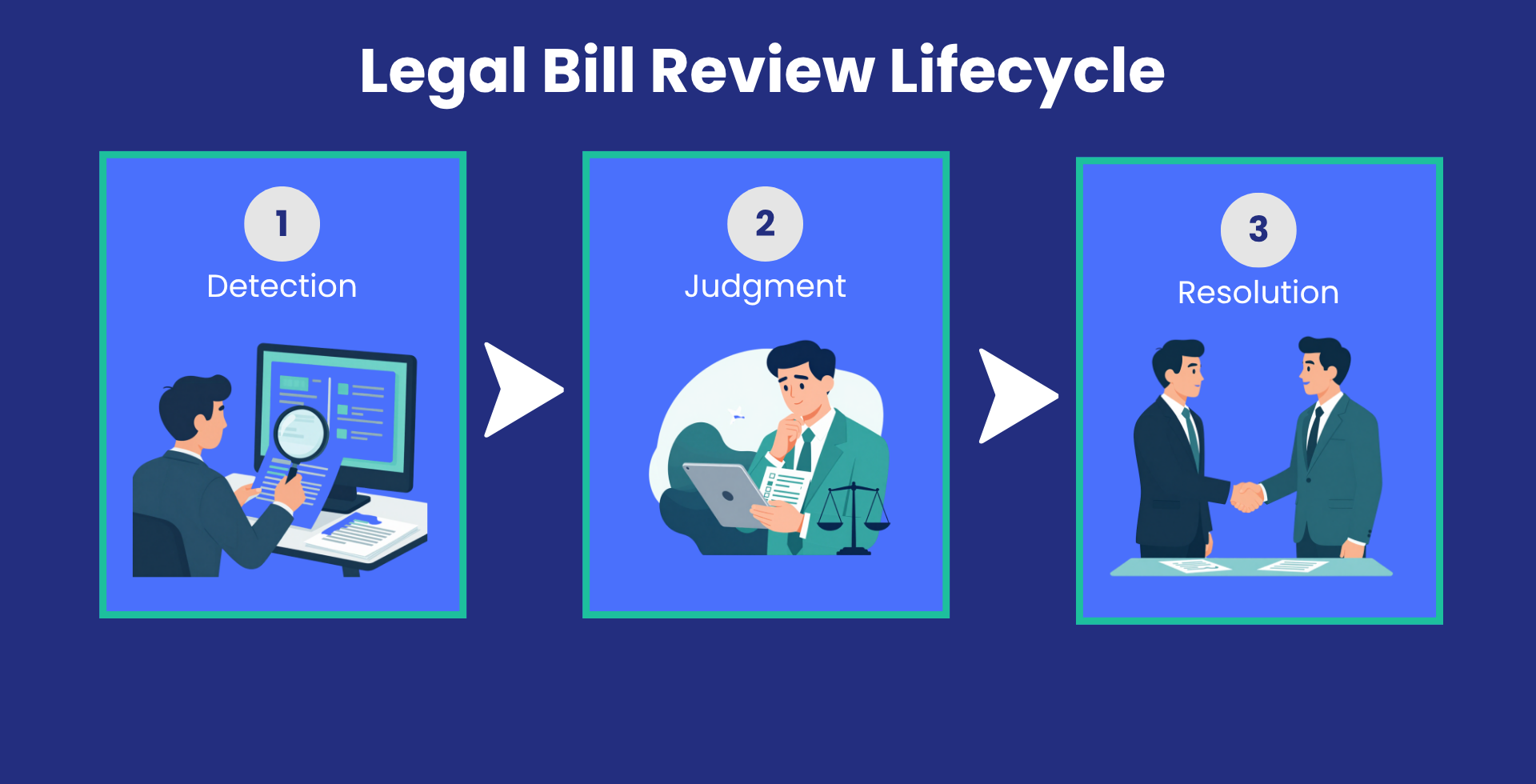
Detection is identifying what's wrong on the invoice: the questionable entries, the guideline breaches, the charges that don't add up. Complete detection accounts for what a rules-based scan returns, what it returns by mistake, and what it never returns at all.
Judgment decides which charges hold up once the work behind them is understood. It catches what detection missed or overstated, and builds the reasoning behind each adjustment into a defensible position that the law firm can review.
Resolution secures the law firm's agreement. An adjustment counts only when the law firm accepts it, which takes documented reasoning and the standing to defend each one on its merits.
It is worth asking where a discrepancy tends to stall. Is everything on the invoice being caught? Are the catches being judged in context, or passed through? Are adjustments resolved with the law firm, or just recorded? Wherever the answer is uncertain is where the budget leaks.
Common Outside Counsel Billing Errors
The five billing discrepancies below are among the most common. Some are caught by rules. Others surface only when someone reads the entry and understands the work behind it.
1. Block Billing
Block billing combines several tasks into a single time entry without breaking out the time for each. An entry reading "Reviewed discovery responses, drafted correspondence to opposing counsel, conferred with team, revised motion, 6.8 hours" gives the client no way to assess whether any one task was reasonable. Some outside counsel guidelines assign a fixed adjustment to block-billed entries by severity, while others reject them outright. Deciding whether an entry is genuinely block-billed and how severe it is takes a reviewer reading it against the guidelines.
2. Vague or Inadequate Time-Entry Narratives
A line item reading "Continued working on client's case, 2.1 hours" passes every automated check. No rule is violated. The entry still says nothing about what was done, so the charge cannot be assessed as billed. A reviewer would ask the law firm to substantiate it or accept an adjustment.
3. Administrative or Clerical Work Billed as Legal Time

Checklist of Common Billing Discrepancies
Organizing files, scheduling, formatting documents, and general data entry are not legal work. When they appear on an invoice as legal rates, the client pays a premium for clerical time. These charges are easy to absorb into a long invoice and easy to overlook.
4. Overstaffing and Inappropriate Staffing
A senior partner billing $975 an hour to summarize deposition transcripts passes every automated check. The rate is within the cap and the task description is compliant. Summarizing transcripts is commonly associate-level work, so the charge is still an error. Overstaffing also happens when more timekeepers attend a meeting or event than the matter requires. Catching it takes a reviewer who knows the task should have gone to a lower-level timekeeper.
5. Duplicative Work
Duplication happens two ways. Multiple timekeepers bill for the same task, or one timekeeper bills twice for the same work across entries. An exact duplicate line item is a clean rule violation. The rest surface only when a reviewer recognizes that two timekeepers billed the same research, the same conference call, or the same draft.
Objective vs. Subjective Billings Errors
Some errors are defined clearly enough in the outside counsel guidelines that make explicit violations unambiguous. A rate over the agreed cap, an exact duplicate entry, and a travel charge outside policy are all examples of objective errors.
Subjective errors need context that the guidelines cannot encode. Whether a narrative describes the work adequately, whether the hours are reasonable for the task, and whether the right timekeeper did the work should be judged by someone who understands the matter.
Finding a Billing Error Isn’t the Same as Resolving It
A detection tool identifies issues. It does not resolve them.
INSIGHT: An April 2026 Chicago Tribune investigation examined how the City of Chicago paid outside counsel invoices while running an e-billing system built to flag billing problems. Over the course of a decade, the system flagged roughly 1,500 invoices because a timekeeper was logged at more than 10 hours in a day, but the City reduced payments on just 139 of them. One invoice covering a trial month listed 162 instances of a timekeeper's daily work exceeding 10 hours; the city paid all of them, including $69,242 for time past the 10-hour mark. The rules existed. The steps that turn a flag into a corrected invoice did not follow.
A flagged entry still has to be judged. Someone has to decide whether the charge is improper or whether the proposed adjustment fits the matter, then carry it to the law firm. Programs stall here when the judgment is never applied and the adjustment is never brought to resolution with the law firms.
How to Address Common Billing Errors
For a lean in-house team, reviewing every invoice across millions of dollars in legal spend is more than the department can take on alone. Departments that control these costs build a repeatable workflow:
Establish enforceable outside counsel guidelines. Define what is billable, set rules for block billing and staffing, and specify how each issue is handled. Learn more about outside counsel guidelines.
Review every invoice against those guidelines. Assess each line item, and judge each discrepancy and proposed adjustment in context.
Resolve adjustments directly with the law firm. An adjustment only counts once the firm accepts it. Document findings at the line-item level and explain the basis for each so the firm understands it.
Track discrepancies over time. Knowing how each law firm bills and which issues recur builds insight into outside counsel behavior. A reporting dashboard, like the one LegalBillReview.com provides, gives that visibility.
INSIGHT: LegalBillReview.com runs the full lifecycle. Every line item on every invoice is analyzed, and each discrepancy is documented with the reasoning behind the adjustment. Reviewing attorneys are assigned by subject matter and stay with a matter for continuity. A separate Law Firm Relations team, drawn from BigLaw and Fortune 100 backgrounds, resolves adjustments with law firms on a peer-to-peer footing.

Gap Analysis
See how your Outside Counsel Guidelines compare against the provisions our U.S.-based licensed attorneys rely on to identify and defend billing adjustments.
Conclusion
Controlling outside counsel spend takes more than a spot check. Knowing the common errors is a starting point, but a budget is protected by what happens after a discrepancy is found: judging whether the charge holds up, then resolving the adjustment with the law firm so it sticks. Detection can point out where a billing error exists, yet deciding what holds up and securing the law firm's agreement takes people who are assigned by expertise and accountable throughout the process.
Contact us to see how much an attorney-led review could find on your outside counsel spend.