
Legal Billing Stories: Real Errors on Outside Counsel Bills
Written By: Michael Coughlin, Esq.; Quality Control Manager
KEY TAKEAWAYS
Billing errors on outside counsel invoices include block billing, vague or inadequate time entry narratives, administrative work billed as legal time, overstaffing, and duplicative work, and they can look ordinary when a charge is read on its own.
Attorney judgment brings the context that e-billing rules and AI-based reviews can miss when invoices are reviewed by automated tools on their own.
An invoice is changed only after each line item moves through detection, judgment, and resolution, ending with the law firm's acceptance of a proposed adjustment.
Outside counsel invoices describe the work a law firm performed and what that work costs. When time entries within those invoices do not hold up, they can leave a legal department paying for work that was duplicated, overstaffed, or poorly described.
This piece covers real examples that LegalBillReview.com's US-based licensed attorneys have found on client invoices. Each example shows what was billed, what the review found, and what attorney judgment revealed within the context that e-billing rules and AI-based reviews can miss when they read each entry on its own.
What Is a Legal Billing Error?
A legal billing error is any charge on an outside counsel invoice that does not hold up against the client's billing guidelines, the engagement terms, or a reasonable standard for the work performed. Common billing errors found on outside counsel invoices can include block billing, vague or inadequate time entry narratives, administrative or clerical work billed as legal time, overstaffing or inappropriate staffing, and duplicative work.
Common Outside Counsel Billing Errors
These examples come from real outside counsel invoices reviewed by LegalBillReview.com's attorneys and cover a range of billing errors. Together, they show how a charge that looks ordinary on an invoice can fail to hold up once judgment from a human-in-the-loop is applied to the work behind it.
September 2026: Excessive Time and Duplicative Work
In a litigation matter heading to trial, two timekeepers reviewed the same 348 pages of party deposition transcripts within 12 days, first to prepare for a hearing and then to prepare for trial.
What was billed: One timekeeper billed 1.3 hours to review the parties' depositions in preparation for a hearing, and 12 days later, a second timekeeper billed 3.8 hours to review the same 348 pages in preparation for trial.
What the review found: A second look at the depositions before trial was reasonable, but the time billed for the review was the issue. The review to prepare for trial should have built on the review completed 12 days earlier, yet it took 2.5 hours longer, nearly three times as long. That gap indicates the earlier work was not carried forward and part of the second review was duplicative.
What attorney judgment revealed: On its own, the 3.8-hour entry describes legitimate work with a stated page count, and trial preparation is a sound reason to revisit depositions. An automated review checking the entry against this narrative could accept it as billed, but a managed bill review judges it in the context of the matter: that the same 348 pages had been reviewed 12 days earlier, and how much of a recent review should carry forward to the next one. Weighing the two entries together showed that the added time went to repeating work already done, which gives the adjustment a specific, documented basis to defend in front of the law firm.
August 2026: Overstaffing
A law firm handled a matter that, under the outside counsel guidelines, limited the staffing to one partner and one associate-level lawyer.
What was billed: Time from five different associates on the same matter.
What the review found: Staffing limits are typically set in a client's outside counsel guidelines, which define how many timekeepers a law firm may assign to a matter and at what levels. The guidelines for this matter allowed one partner and one associate. By staffing five associates, the law firm exceeded that limit, meaning charges from associates beyond the one permitted fall outside the guidelines the law firm agreed to follow.
What attorney judgment revealed: Counting timekeepers against a staffing limit is straightforward, but deciding what the overage means for the invoice takes judgment. With five associates billing on one matter, someone has to determine which time reflects the permitted associate's role, whether one associate replaced another, and whether new associates billed time getting up to speed on a file another associate already knew. Those answers come from someone reading the entries against the guidelines and understanding the course of the matter. Software that simply counts timekeepers on an invoice cannot provide that context.
July 2026: Inadequate Descriptions and Excessive Time
In a litigation matter, a timekeeper prepared 17 subpoenas for records, a routine task that formally requests documents from a third party.
What was billed: Three separate charges for each of the 17 subpoenas: 0.4 hours to prepare each subpoena, 0.2 hours to revise each subpoena, and 0.3 hours to verify the contact information for each subpoena. Together, the charges totaled 15.3 hours billed to the client.
What the review found: While preparing each subpoena does require changing the names and addresses on a standard form, each one was billed at 0.9 hours across three charges. The revision charges never stated what was revised or why all 17 subpoenas needed revision in the first place. In total, the charges came to 15.3 hours for work that is typically completed in less time.
What attorney judgment revealed: Each of the 51 charges is small, and on its face, each looks either reasonable or too minor to question, which is how an automated review applying rules to one entry at a time could clear all of them. The issue appears when the charges are grouped by task and weighed against how long preparing a records subpoena from a standard form actually takes. That standard comes from an experienced attorney knowing how the work is done, and applying it showed 15.3 hours billed for work was more than necessary.
Why Finding a Billing Error Does Not Correct the Invoice
An invoice is corrected when the law firm accepts an adjustment and the amount owed changes to reflect it. Finding a billing error only identifies a charge that may not hold up. For an invoice to be adjusted, that finding must move through all three stages of bill review: detection, judgment, and resolution.
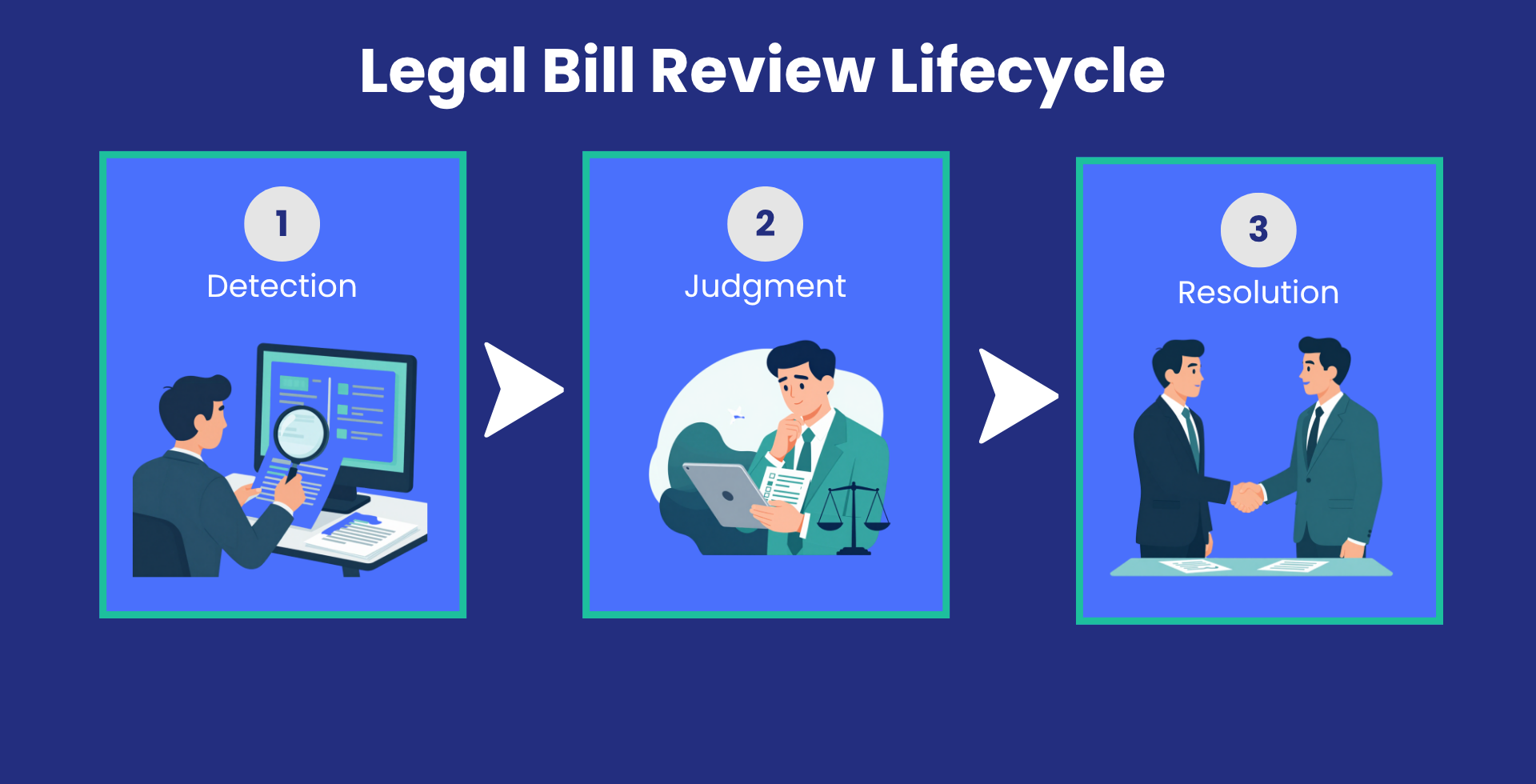
Detection identifies which entries on an invoice need further evaluation. When detection is run thoroughly, it accounts for what an automated rules-based system surfaces correctly, what it surfaces in error, and what it misses entirely.
Judgment weighs each line item in the context of the work behind it. This determines what genuinely holds up, then frames the reasoning for any adjustment so it stands up to the law firm's review.
Resolution is where an adjustment is settled with the law firm and agreed to. A proposed change holds no value until the law firm agrees to it, which calls for documented reasoning and the credibility to defend each adjustment.
What corrects an invoice is an adjustment the law firm accepts, backed by reasoning that is grounded in the specifics of the matter and the work behind each charge. A billing error that is detected but never judged or resolved leaves the invoice exactly as it was billed, and puts the legal department at risk for paying for an error that was found but never corrected.
INSIGHT: An April 2026 Chicago Tribune investigation found that the City of Chicago, despite having an e-billing system built to flag billing problems, paid outside counsel invoices the system had flagged. Over the course of a decade, the system flagged roughly 1,500 invoices because a timekeeper was logged at more than 10 hours in a day, but the City reduced payments on just 139 of them. One invoice covering a trial month listed 162 instances of a timekeeper's daily work exceeding 10 hours. The City paid all of them, including nearly $70,000 for time past the 10-hour mark. A flag changes an invoice only when someone with the expertise to judge the charge weighs it against the work and takes the adjustment to the law firm.
Conclusion
Charges on outside counsel invoices can look reasonable when read on their own. The problems surface when an attorney reads each line item in the context of the matter, such as against an earlier entry, the outside counsel guidelines, or how long the work should take. That context is what e-billing rules and AI-based reviews can miss when invoices are reviewed by automated tools alone.
For in-house legal teams, running each invoice through all three stages of bill review is what turns a line-by-line review into adjustments that hold up with the law firm. Legal departments that understand the value attorney-led review adds are better equipped to find where their budget is leaking and strengthen their bill review program.
To learn more about how to control outside counsel spend, contact a LegalBillReview.com expert today.