

Legal Bill Review for Technology Companies
What legal departments at technology companies need to know about managed legal bill review and controlling outside counsel spend.
Outside counsel spend is a large budget item for technology legal departments, and those costs can add up quickly when litigation runs its course. As invoices steadily come in, each one has to be checked against agreed-upon outside counsel guidelines before any payment is made. LegalBillReview.com is a managed legal bill review service that helps in-house legal teams at technology companies control spending by analyzing invoices with its US-based licensed attorneys and gaining agreement on those adjustments directly with the law firms for realized savings.
Legal Matters Technology Companies Send to Outside Counsel
Technology companies send a range of matters to outside counsel. Each matter appears on outside counsel invoices and has to be checked against the guidelines before those invoices are paid. Common matters requiring outside counsel include, but are not limited to:
Intellectual Property
Intellectual property covers disputes over what a technology company builds, like patents on its software, copyrights on its code, and trade secrets such as proprietary algorithms. Attorneys who specialize in this area typically have hourly rates that can run among the highest in the industry, and their work rarely resembles ordinary litigation. Analyzing their invoices takes a reviewing attorney who is fluent in how an IP practice operates, especially one built around technology. On most litigation bills, a line for "tracking deadlines" reads as clerical, but on an IP invoice, it can be the docketing that keeps a trademark from being abandoned. Oversight is necessary for these matters, and has to come from a reviewer who understands the practice, so each adjustment carries reasoning the law firm can review and outside counsel spend remains accountable.
Data Security and Privacy
Data security and privacy cover protecting the information a technology company holds and defending it if that protection fails, like responding to a data breach, the customer lawsuits that follow, and answering regulators afterward. One breach can bring suits in several states at once, each with its own local law firm, so the same research and the same filings can be billed separately in every case, at each law firm's own rates.
Cross-Border and International Business
Cross-border and international business covers the legal work of operating in other countries, like setting up an entity abroad, meeting local laws that protect consumers, and contracts governed by foreign law. Local counsel handles the work in each country, and the primary law firm coordinates it, so if guidelines aren’t thorough and enforced, the same task can be billed twice, once abroad and again as oversight. This is a particular risk for technology-based companies, where new and developing oversight emerges in the US and Europe every day; a multinational law firm with offices in New York and London might be billing associates in each location to redline the same global governance document.
Mergers and Acquisitions
Mergers and acquisitions cover buying and selling companies, like acquiring a startup, raising outside investment, or divesting a product line. These deals are known for running past their legal budgets, partly because several law firms may be redlining the same agreements at once with no oversight on the combined bill. Law firms have also historically staffed first-year associates on these large deals as a way to train them, meaning the client pays for that education because those documents are often reviewed again by senior attorneys. A reviewing attorney with transactional experience can tell when it is an excuse to overbill.
Regulatory and Compliance
Regulatory and compliance covers the work of keeping a technology company within the rules that govern it, like consumer protection standards, rules of online service for minors, and what follows when regulators start investigating. Privacy laws such as the GDPR and CCPA add their own burden, and keeping them current can be expensive on its own. Unlike a lawsuit, this work can be ongoing, and it is usually treated as a cost of doing business, but that cost still needs to be justified. An annual filing like a 10-K can show dozens of attorneys billing against one document, and when invoices don’t show who contributed what, entries like that can grow quickly without proper checks and balances.
What Complete Bill Review Looks Like
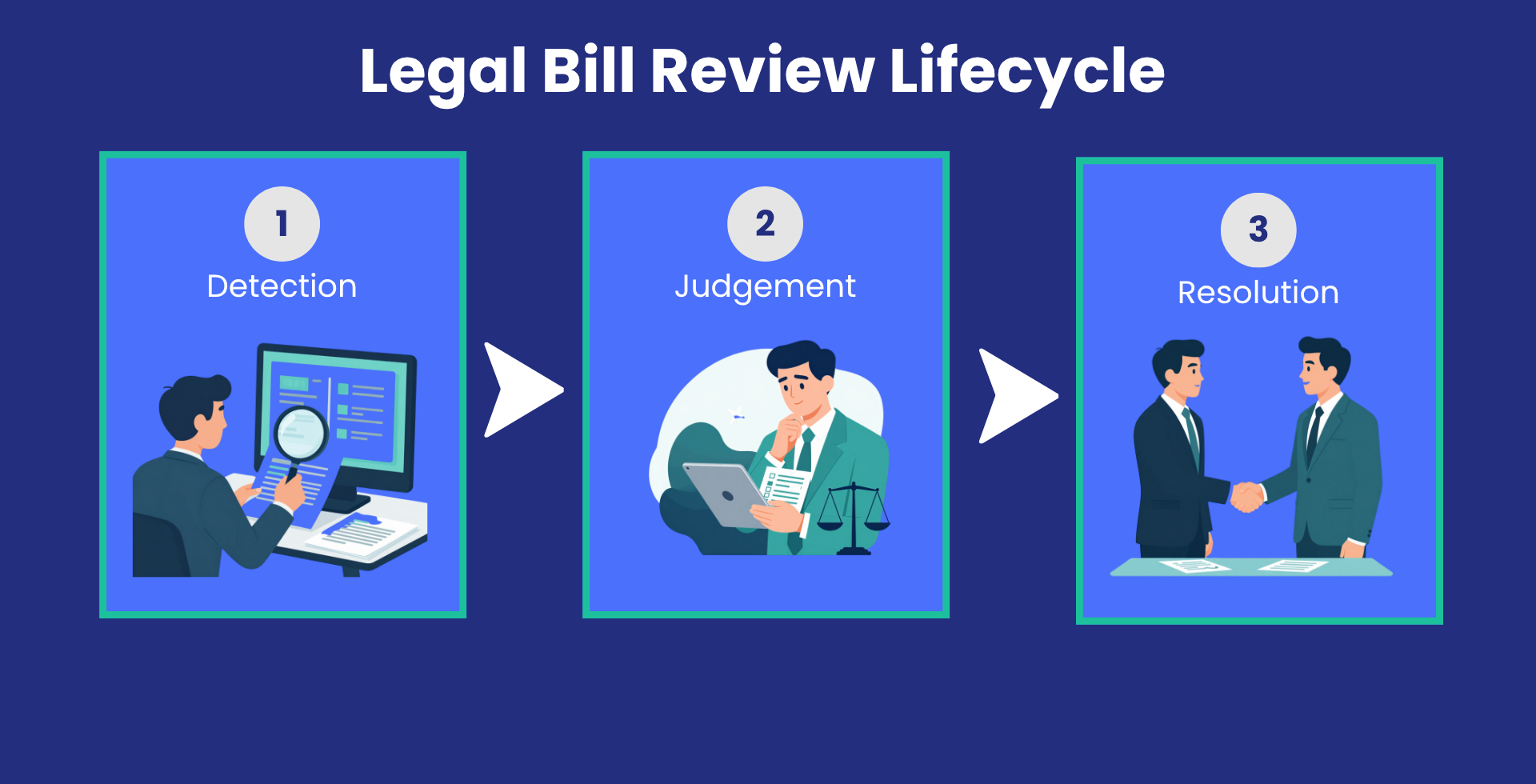
Legal bill review is the process of examining outside counsel invoices for billing errors, unauthorized charges, and compliance with outside billing guidelines. The most effective programs cover all three of the following stages: detection, judgment, and resolution. While detection identifies billing discrepancies and judgment applies legal context to decide which line items hold and which warrant adjustments, resolution is what turns adjustments into realized savings.
With a managed bill review service, technology companies have their bill review process owned by a provider that carries outside counsel invoices through all three stages. Managed bill review complements many e-billing systems legal departments already have in place, and any adjustments to invoices are communicated directly to the law firms, so the day-to-day review work never falls on the in-house team.
How Technology Companies Save on Outside Counsel Spend
In this case study, LegalBillReview.com’s US-based licensed attorneys reviewed a technology company's outside counsel invoices and, during one review period, identified 33.3% in overcharges and discrepancies. After sending the adjusted bill to the law firm, the dedicated Law Firm Relations team secured 30.1% in realized savings for the client. A review can identify savings, but someone has to take those findings to the law firm and gain agreement, because only the adjustments the law firm accepts are what actually come off the client's bill.
identified
Why Technology Companies Choose LegalBillReview.com
Outside counsel invoices that LegalBillReview.com reviews for a technology company are analyzed by US-based licensed attorneys assigned based on subject-matter expertise, which means they have unique experience in the practice of technology-related law. Every line item is measured against the client’s outside counsel guidelines, and when a billing discrepancy is found, it’s documented with the reasoning behind the adjustment and presented to the law firm. A separate Law Firm Relations team, drawn from BigLaw and Fortune 100 backgrounds, then addresses those conversations directly and resolves adjustments with the law firms on a peer-to-peer footing. This process is backed by LegalBillReview.com’s performance guarantee: the total adjusted invoices plus our fee will not exceed the original billed amount for any review period.
LegalBillReview.com Services
Technology companies looking to outsource comprehensive bill review can start by layering LegalBillReview.com on top of existing processes or as a standalone program. If your outside counsel spend is $5M or more annually, then overbilling isn’t just possible - it’s probable, and we could help you save valuable time and money. To see what a complete review could find across your outside counsel invoices, contact an expert today.
Last updated: August 2026