

Legal Bill Review for Insurance Companies
What insurance legal departments need to know about managed legal bill review and controlling outside counsel spend.
Outside counsel spend is a large budget item for insurance legal departments, and those costs can add up quickly when litigation runs its course. As invoices steadily come in, each one has to be checked against agreed-upon outside counsel guidelines before any payment is made. LegalBillReview.com is a managed legal bill review service that helps in-house legal teams at insurance companies control that spend by analyzing invoices with its US-based licensed attorneys and gaining agreement on those adjustments directly with the law firms for realized savings.
Legal Matters Insurance Companies Send to Outside Counsel
Insurance companies send a range of matters to their outside counsel. Each matter appears on outside counsel invoices and has to be checked against the guidelines before those invoices are paid. Common matters sent to outside counsel include, but are not limited to:
Construction Defect and Contractor Liability
Construction defect and contractor liability covers defect and injury claims involving builders and the trades: flooring, masonry, plumbing, and heating and cooling. A single lawsuit can pull in the builder, the subcontractors, and their carriers. Every party potentially adds timekeepers to the bill, and billing errors are easy to absorb into an invoice of that size.
Premises Liability and General Liability
Premises liability and general liability defense covers on-premises bodily injury claims against insured businesses, from restaurants and bars to hotels and resorts. An Insurance company funds this defense across its book of business. Without a thorough legal bill review process in place at that volume, it’s easy to overspend on billing discrepancies.
Motor-Vehicle Accident Liability
Motor-vehicle accident liability spans auto and commercial-vehicle bodily-injury claims, from personal auto files to the trucking cases that make headlines. Most of these files move through the same stages: pleadings, discovery, depositions, settlement. Invoices can look alike file after file, so without a consistent review program, an improper billing habit that slips through one invoice can be carried across every file it touches.
Subrogation and Recovery
Subrogation and recovery occur when a carrier pays its policyholder's claim for damage that was someone else's fault and pursues the responsible party, usually that party's insurer, to collect what it paid out. Law firms handle that pursuit, and their invoices count against what comes back. These files are measured by what they bring in after legal costs, so a billing error on a recovery invoice takes money straight off the result.
What Complete Bill Review Looks Like
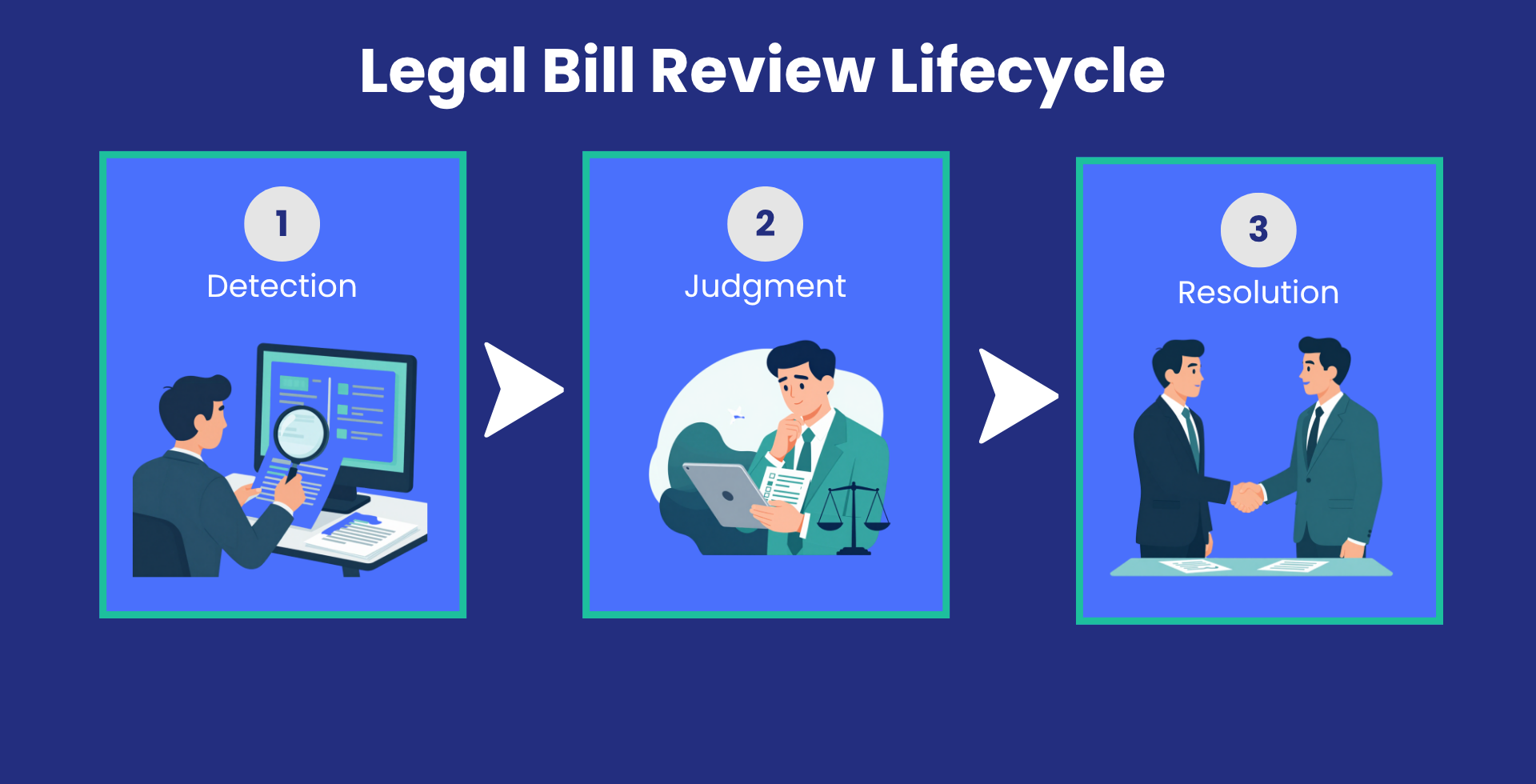
Legal bill review is the process of examining outside counsel invoices for billing errors, unauthorized charges, and compliance with outside billing guidelines. The most effective programs cover all three of the following stages: detection, judgment, and resolution. While detection identifies billing discrepancies and judgment applies legal context to decide which line items hold and which warrant adjustments, resolution is what turns adjustments into realized savings.
With a managed bill review service, insurance companies have their bill review process owned by a provider that carries outside counsel invoices through all three stages. Managed bill review complements many e-billing systems legal departments already have in place, and any adjustments to invoices are communicated directly to the law firms, so the day-to-day review work never falls on the in-house team.
How Insurance Companies Save on Outside Counsel Spend
In this case study, LegalBillReview.com’s US-based licensed attorneys reviewed a specialty insurance company's outside counsel invoices and, on one invoice, identified 20.6% in overcharges and discrepancies. After sending the adjusted bill to the law firm, the dedicated Law Firm Relations team secured 16.2% in realized savings for the client. A review can identify savings, but someone has to take those findings to the law firm and gain agreement, because only accepted adjustments are what actually come off the client's bill.
identified
“Thank you very much for helping us! Some of these law firms have been overbilling us in the past, and this had to stop.”
Why Insurance Companies Choose LegalBillReview.com
Outside counsel invoices that LegalBillReview.com reviews for an insurance company are analyzed by US-based licensed attorneys assigned based on subject-matter expertise, which means they have unique experience in the practice of insurance-related law. Every line item is measured against the client’s outside counsel guidelines, and when a billing discrepancy is found, it’s documented with the reasoning behind the adjustment and presented to the law firm. A separate Law Firm Relations team, drawn from BigLaw and Fortune 100 backgrounds, then addresses those conversations directly and resolves adjustments with the law firms on a peer-to-peer footing. This process is backed by LegalBillReview.com’s performance guarantee: the total adjusted invoices plus our fee will not exceed the original billed amount for any review period.
LegalBillReview.com Services
Insurance companies looking to outsource comprehensive bill review can get started by layering LegalBillReview.com on top of existing processes or as a standalone program. If your outside counsel spend is $5M or more annually, then overbilling isn’t just possible - it’s probable, and we could help you save valuable time and money. To see what a complete review could find across your outside counsel invoices, contact an expert today.
Last updated: August 2026