
Legal Billing Rates in 2026: What to Negotiate and How to Reduce Outside Legal Spend
Written By: Operations Department
KEY TAKEAWAYS
Average standard billing rates increased 9.6% year over year in 2025.
Am Law 50 firms saw rates grow 10.4% in 2025.
Companies using structured outside counsel billing guidelines and a dedicated legal bill review provider typically see significant reductions in billed amounts.
Average standard law firm billing rates increased 9.6% year over year in 2025, continuing an upward trend that shows no signs of slowing. For general counsel and legal operations leaders managing $5 million or more in annual legal spend, understanding where rates stand and what levers you can pull is essential to managing outside counsel costs effectively.
To help better understand the trend of law firm rate increases, LegalBillReview.com explains how in-house teams can protect their budgets. Knowing the latest legal billing rate benchmarks gives corporate legal leaders the tools needed to implement practical strategies that negotiate rates, spot billing discrepancies, and establish outside counsel billing guidelines.
What Are Average Law Firm Billing Rates in 2026?
Law firm billing rates vary significantly by geography, firm size, practice area, and timekeeper seniority, and the trend of rates increasing continues to accelerate. While the hourly standard billing rate grew 9.6% across the board for average law firms, Am Law 50 firms posted higher increases of 10.4%.
At the top of the market, rates have reached unprecedented levels, with senior partners at some of the biggest firms in the country charging up to $4,000 per hour in 2026. The Valeo 2026 Early Indicators Report confirms that 2026 rate changes are greater than those for the same firms in 2025.
Here is a snapshot of how the average hourly rate has increased over the past two years. This data is a blended average across all timekeeper levels based on LegalBillReview.com’s own internal data.
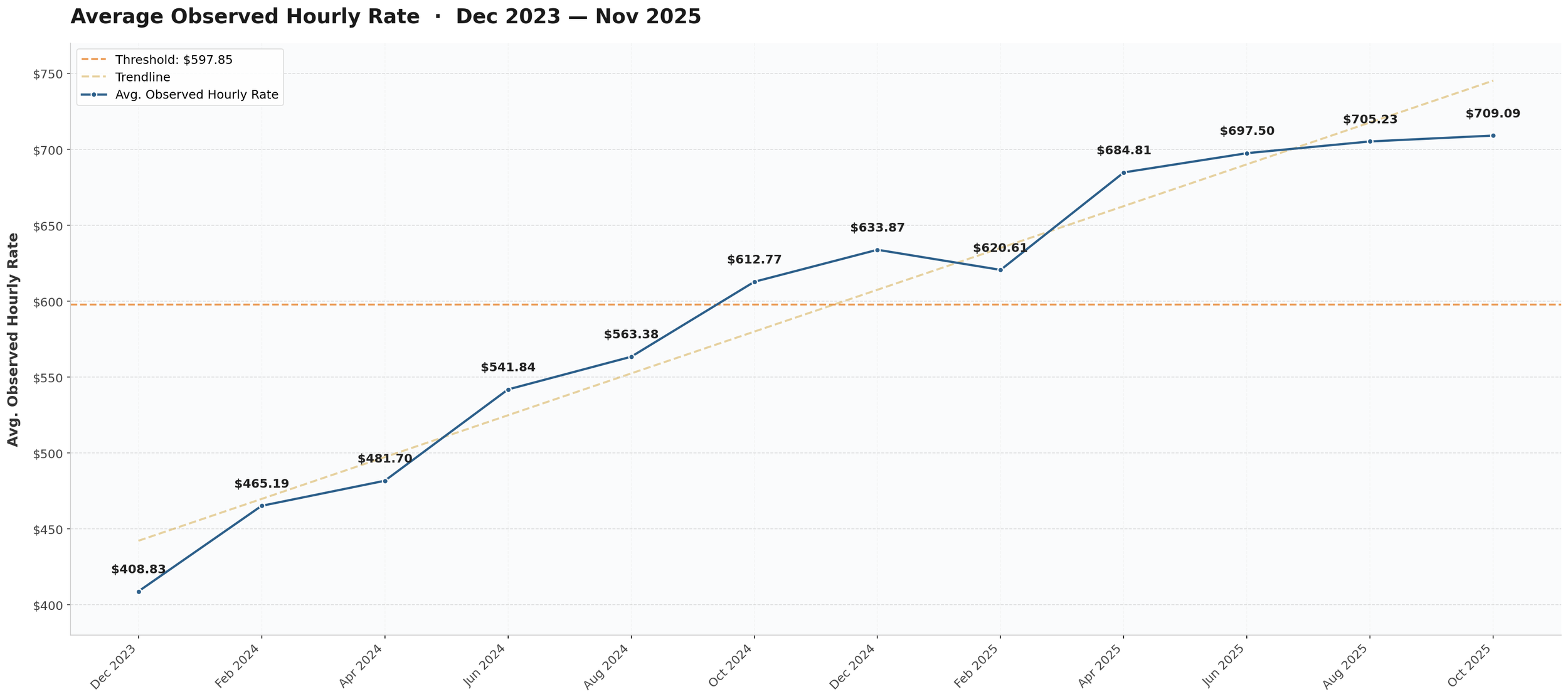
Understanding these benchmarks is the first step in effective legal spend management. If rates sit above the median without a clear justification, it is worth opening a conversation about legal billing adjustments.
How to Approach Better Law Firm Billing Rates
Rate negotiation is as much about preparation as it is about leverage. The most effective legal departments approach rate discussions with data and structured guidelines.
Negotiate at the Start of Engagement, Not Annually
Many companies passively accept annual rate increases, even though law firm costs may not necessarily increase at the start of every year. In-house legal teams have a right to set expectations prior to the engagement and state that the specific matter will determine rates, which will remain fixed for the entirety of that matter.
“At the start of an engagement, clients should be clear that they will not agree to rate increases simply for the sake of increases.”
They can also negotiate rate ranges based on the level of the person doing the work (i.e., junior associates, senior associates, equity partners), rather than annual rate increases for each individual. Rate negotiations should be a recurring discipline and tied to performance.
Benchmarking the Market
Knowing the market rate for similar work can help benchmark current rates against law firms. If a litigation partner in Chicago is billing $1,000 per hour but the median for that market and practice area is $875, you have data driving a conversation about adjusting rates.
Establish Outside Counsel Billing Guidelines
Formalized outside counsel billing guidelines set expectations from the start. They define which activities are billable, establish rate caps by timekeeper level, and specify rules around block billing, staffing, expenses, and more. Companies with well-enforced billing guidelines consistently achieve better legal spend outcomes, but without enforcement, guidelines are effectively meaningless.

Checklist of Common Billing Discrepancies
INSIGHT: LegalBillReview.com helped a major cosmetics brand implement industry-standard outside counsel guidelines by drafting and presenting guidelines directly to the company’s law firms. As a seamless extension of the legal ops team, LegalBillReview.com reviewed and approved all invoices going forward, enabling the company to save over $100,000 in outside counsel legal costs within the first year of engagement, while freeing up time previously spent on manual invoice review by the in-house team.
Explore Alternative Fee Arrangements
Hourly billing remains the dominant structure for outside counsel engagements, but it's not the only option. Alternative fee arrangements (AFAs) give corporate legal departments a mechanism for controlling predictability on select matters before a single hour is logged.
Common AFA structures worth evaluating by matter type:
Fixed or flat fees: well-suited for high-volume, repeatable IP work such as patent prosecution or trademark filings
Capped fees: effective for M&A transactions and complex litigation where scope is uncertain but exposure needs a ceiling
Blended rates: reduce the impact of rate variation across timekeeper levels within a single engagement
Success or contingency fees: appropriate for affirmative litigation where outcome alignment with outside counsel is possible
However, AFAs represent a fraction of total outside counsel spend for most corporate legal departments. According to Thomson Reuters' State of the US Legal Market report, 90% of legal dollars still flow through standard hourly rate arrangements, meaning most of your spend is already subject to optimization.
That's where a legal bill review service delivers direct, measurable value. AFAs create cost certainty on select matters, but the majority of your outside counsel spend, which is still billed by the hour, shows up on invoices that go unreviewed without a dedicated process in place. A legal bill review partner, like LegalBillReview.com, reviews hourly invoices line by line, analyzing each charge against your Outside Counsel Guidelines and identifying reductions on spend that would otherwise go unquestioned. The two strategies can be complementary: use AFAs where scope permits, and legal bill review to govern the hourly spend that remains.
How Legal Bill Review Helps Control Outside Spend
Negotiating a good rate is half the challenge to lowering outside legal spend. Without a robust legal bill review, there is no assurance that negotiated rates and guidelines are actually being followed, which is how overbilling goes unnoticed. A comprehensive legal bill review program encompasses the entire lifecycle of managing outside counsel costs, from establishing rules and guidelines to enforcing them on every legal invoice.
When partnering with a third-party provider, like LegalBillReview.com, the lifecycle begins with drafting outside counsel guidelines. Once those are established, your provider will communicate and manage the law firm's expectations regarding those guidelines directly. Every bill undergoes a detailed analysis to identify violations of the previously established and agreed-upon guidelines. When discrepancies are found, they are presented to the law firm, and if the firm disagrees with the findings, your bill review provider will negotiate bill adjustments directly through an appeals process. This is done all without disrupting your existing workflows.
“If a law firm pushes back on adjustments, we often start the conversation by asking, ‘Where did we go wrong, and how can we work together to resolve this?’ Our focus is on the guidelines and resolution—not causing friction or frustration.”
Part of the lifecycle that many legal operations leaders overlook is evaluating a law firm’s performance. Having real-time data, such as a live dashboard, that shows which invoices are under review, enables in-house legal teams to access the reporting and analytics they need to make informed decisions about how they manage their legal spend.
Companies that implement a consistent legal invoicing review process through a third-party legal bill review provider typically recover significant savings on billed amounts.
INSIGHT: LegalBillReview.com recently helped a major US retailer reduce its legal spend by 8%, resulting in nearly $200,000 in savings in just one year. While the percentage of savings can vary, this engagement demonstrates that even well-run legal departments leave meaningful savings on the table without a dedicated bill review process.
Building a Proactive Legal Spend Management Strategy
While rate benchmarking and invoice review are essential, the most effective legal departments embed other practices into a broader legal spend management strategy.
Set budgets by matter type: Establish expected costs for common matter types, and ensure that individual matters don’t deviate from budget limits.
Enforce billing guidelines consistently: Leverage your legal billing software and legal bill review provider. If using a provider, ensure they communicate issues to your law firms.
Track rate trends over time: Monitor how rates across your panel of firms have increased year over year to negotiate fair, comparable rates.
Consolidate and right-size your panel: Concentrating work with fewer firms increases your leverage, but do not rely too heavily on any single firm either. Live data, like a client dashboard, gives you visibility into how your law firms are billing, common billing discrepancies by type, real-time invoice status updates, and more.
Frequently Asked Questions
-
While reports vary, standard rates grew on average 9.6% year over year in 2025. Average Am Law 100 rates cracked $1,000 per hour, but depending on firm size and market, senior partners at elite firms can command $2,000-$4,000 per hour.
-
Common signs of law firm overbilling include block billing or excessive time on routine work. See this list for more details on the types of billing discrepancies we see at LegalBillReview.com. A structured legal bill review process is the most reliable way to identify and address these issues.
-
Outside counsel billing guidelines are formal policies that define what law firms can and cannot bill for, including approved rates, billing increment rules, expense policies, and staffing expectations. They provide an enforceable framework for managing legal costs and are essential for any effective legal spend management program. These guidelines should be maintained as best practices evolve, and any changes should be communicated to law firms before they are enforced. A dedicated legal bill review partner can assist with the development and maintenance of this important document, as well as with communicating billing guidelines to law firms
-
While actual dollar amounts can vary, companies that implement consistent legal bill review typically recover significant savings from billed amounts through the identification of billing errors, guideline violations, and rate discrepancies.
Conclusion
Companies that control their budgets for outside legal spend are those that proactively seek new strategies to reduce costs. As corporate legal departments remain under pressure with tighter budgets, understanding the fair market value of what they receive from outside counsel is more important than ever, and relying on a trusted legal bill review is an ongoing process. Understanding current rate benchmarks, establishing and enforcing outside counsel billing guidelines, negotiating with data, and implementing a disciplined review process can help organizations manage outside counsel costs without sacrificing quality.
Ready to take control of your outside counsel legal bills? Contact us today and see how much you can save with a legal bill review.